
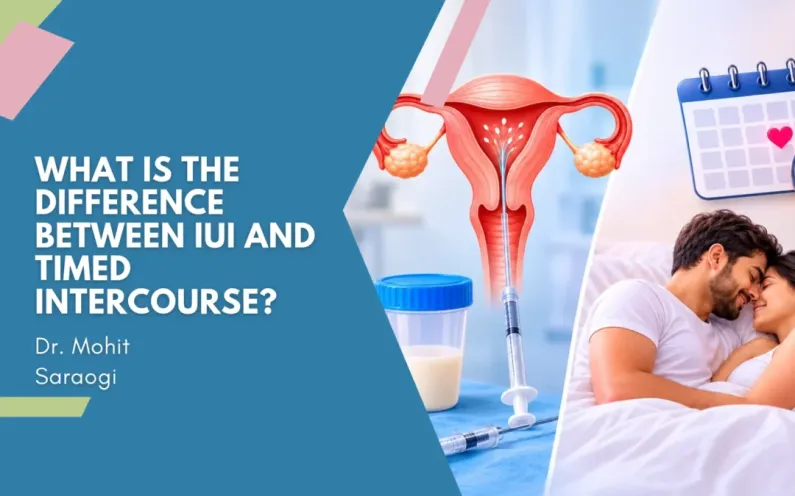
The main difference between IUI and timed intercourse is how the sperm reaches the egg. With timed intercourse, a couple has natural sex during the fertile window around ovulation. With IUI, the lab washes and concentrates the sperm, and a doctor places it inside the womb with a thin catheter.
According to Dr. Mohit Saraogi, IVF Doctor in Mumbai, “Timed intercourse is usually the first step, and IUI is considered when natural attempts haven’t worked or there is a known reason. The right choice depends on your cycle, sperm quality and how long you have been trying.”
Want to understand which option suits different fertility situations?
How Does Timed Intercourse Work?
Timed intercourse needs no procedure at all. You simply plan sex around the days when you are most likely to conceive.
Tracking ovulation: Most women track the cycle with an app, ovulation kits or a basic ultrasound. The aim is to spot the day the egg is released.
The fertile window: It lasts about 6 days, which includes the 5 days before ovulation and the day itself. The 2 days right before ovulation are usually the best.
How often: Sex every 1 to 2 days during that window is enough. Doing it more often doesn’t raise the chances.
Ovulation medicines: Some women take tablets such as letrozole to help an egg develop. Even then, sperm still reach the egg naturally.
Timed intercourse is often where doctors begin, and our infertility treatment page explains what comes next if it doesn’t work.
How Is IUI Different From Timed Intercourse?
Both options try to get healthy sperm close to the egg at the right time. IUI just gives the sperm a bit of a head start. Here’s how they compare.
| Point | Timed Intercourse | IUI |
|---|---|---|
| How sperm reaches the egg | Swims through the vagina and cervix on its own | Placed straight into the womb with a thin catheter |
| Sperm preparation | None, the sample is used as it is | The lab washes it and keeps the most active sperm |
| Where it happens | At home | In the clinic over a few minutes, with no anaesthesia |
| Timing | Based on tracking your cycle | Planned with an ultrasound or a trigger shot |
| How it feels | Like natural intercourse | Like a routine pelvic exam |
Timing is the part that needs the most care in IUI. Our blog on the trigger shot explains how the doctor picks the right hour.
Who May Need IUI Instead of Timed Intercourse?
Timed intercourse is a fair first step for many couples. IUI usually comes in when there’s a reason natural attempts may struggle.
Mild male factor issues: A slightly low count or reduced movement can make it harder for sperm to reach the egg. Washing the sample can help.
Cervical mucus problems: Thick mucus or cervical scarring can block sperm. IUI bypasses the cervix completely.
Unexplained infertility: When tests show no clear cause after months of trying, doctors often try IUI before moving to IVF.
Donor sperm or difficulty with intercourse: IUI is the usual route with donor sperm, and also when sex is painful or not possible.
If IUI cycles don’t lead to pregnancy, the next step may be IVF. Our blog on ICSI embryo transfer success rates explains what that involves.
Wondering if IUI is the right next step for you?
Frequently Asked Questions
What is the difference between IUI and timed intercourse?
Timed intercourse means planned natural sex during the fertile window. IUI places washed sperm directly inside the womb with a thin catheter, close to ovulation.
Is IUI more effective than timed intercourse?
It depends on the cause of the delay. IUI may help with mild male factor or mucus issues, but results are similar in some cases, so your doctor decides.
Is IUI painful compared with timed intercourse?
IUI usually causes only mild cramping, similar to a pap smear. Most women feel little discomfort, and the procedure is over within a few minutes.
How long should we try timed intercourse before IUI?
Doctors often advise trying for 12 months, or 6 months if the woman is over 35. With a known cause, IUI may be suggested sooner.
References:
- PubMed: Timed intercourse for couples trying to conceive. https://pubmed.ncbi.nlm.nih.gov/37709293/
- PubMed: Intra-uterine insemination for unexplained subfertility. https://pubmed.ncbi.nlm.nih.gov/22972053/
Disclaimer:
This blog is intended for informational purposes only and should not be considered a substitute for professional medical advice, diagnosis, or treatment.