
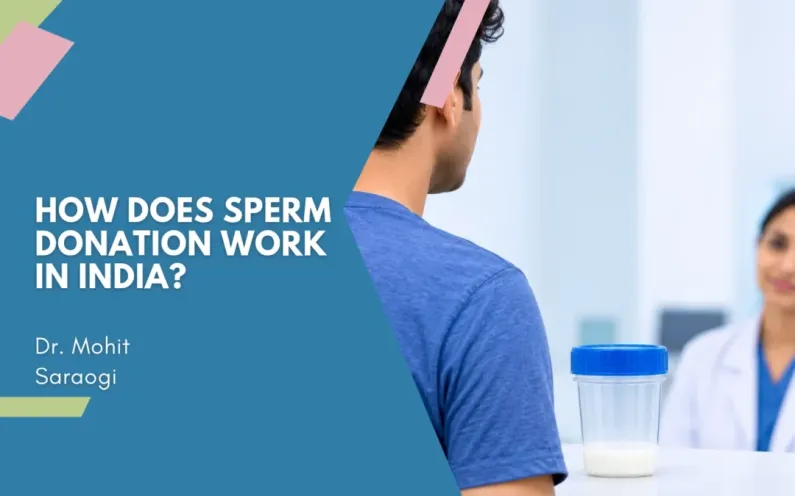
Sperm donation in India has to go through a legally registered ART clinic or sperm bank, which follows national ART rules and ICMR guidance. The donor gives consent, goes through health checks and screening, and the sample is stored before any use. Private arrangements and middlemen aren’t allowed.
According to Dr. Mohit Saraogi, IVF Doctor in Mumbai, “Sperm donation is a regulated process in India, and every donor goes through consent, counselling and screening before a sample is used. The aim is to protect the donor, the recipient and the child.”
Want to know how sperm donation is regulated in India?
Who Can Donate Sperm in India?
Not every man can become a donor, and that’s by design. A registered bank checks a few basics first.
Age: Donors must be men aged 21 to 55. Anyone outside that range can’t be accepted.
General health: The bank checks the donor’s medical history and family history. A serious illness usually rules a donor out.
Written consent: Every donor signs a consent form and a confidentiality undertaking. By donating, he gives up all parental rights over any child born.
A registered bank only: Donors have to go through a registered ART bank or clinic. Selling sperm or finding donors through agents isn’t allowed.
Donor sperm is one of several routes in fertility care, and our infertility treatment page explains how doctors decide which one fits.
How Is a Sperm Donor Screened?
Screening is the longest part of the process. The bank tests both the donor and the sample before it reaches a patient.
Infection tests: Donors are tested for HIV, hepatitis B, hepatitis C and syphilis. A positive result means the donor is not accepted.
Semen analysis: The lab checks sperm count, movement and shape. The sample also has to survive freezing and thawing well.
Medical and family history: Questions cover inherited conditions and illnesses in the family. No test is perfect, but this lowers the risk.
Quarantine and retesting: Samples are frozen and held back for a set period, usually about 6 months. The donor is tested again before the sample is released.
The same care applies to egg donors, and our blog on how egg donors are screened shows how it works on that side.
How Is Donor Sperm Used in Treatment?
Once a sample clears screening, it can be used in treatment. The process is private and tightly regulated.
IUI or IVF: Donor sperm is most often used for IUI. If needed, it can also be used for IVF or ICSI.
One couple only: One donor’s sperm can’t be supplied to more than one couple. This is a rule under the ART Act 2021.
Confidentiality: Clinics and banks must keep donor and recipient details private. They can be shared only in limited cases, such as a court order.
Parental rights: A child born this way is legally the child of the couple who commissioned the treatment, not the donor.
Donor sperm can also be used in IVF when IUI isn’t enough, and our blog on ICSI embryo transfer success rates explains what to expect.
Curious about how donor sperm is used in fertility treatment?
Frequently Asked Questions
How does sperm donation work in India?
Donors go through a registered ART bank or clinic, where they give consent and are screened. The sample is frozen, quarantined and used only after it clears testing.
Is sperm donation legal in India?
Yes, when it is done through a registered ART clinic or bank under the ART Act 2021. Selling sperm or using agents to find donors is not allowed.
Who can donate sperm in India?
Healthy men aged 21 to 55 can donate, after consent and screening. The bank also checks medical and family history before it accepts a donor.
Is a sperm donor’s identity kept confidential?
Yes, clinics and banks must keep donor details confidential. Information can be shared only in limited cases, such as a medical emergency or a court order.
References:
- PMC (NIH/NLM): Assisted Reproductive Technology (Regulation) Act 2021: Critique and Contestations. https://pmc.ncbi.nlm.nih.gov/articles/PMC10994889/
- PubMed: Gamete and embryo donation guidance. https://pubmed.ncbi.nlm.nih.gov/38970576/
Disclaimer:
This blog is intended for informational purposes only and should not be considered a substitute for professional medical advice, diagnosis, or treatment.