
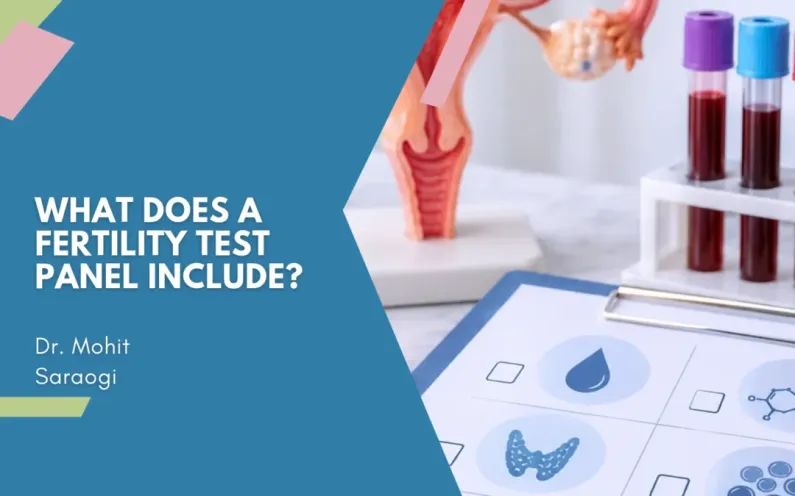
Fertility test panel is a series of tests conducted on both the male and female to determine the problem when the pregnancy has been delayed. Typically, fertility testing includes an assessment of blood hormone levels, a uterine and ovarian scan, and a semen analysis. They work together to assist the doctor in determining what may be affecting conception.
According to Dr. Mohit Saraogi, IVF Doctor in Mumbai, “Fertility testing works best when both partners are checked together, because the cause can sit with either one. We choose the tests based on age, cycle pattern and medical history, so nobody repeats what they don’t need.”
Want to know what a basic fertility test panel looks like?
Which Blood Tests Are Part of a Fertility Test Panel?
These blood tests provide the initial look at egg reserve, ovulation and thyroid wellness. There are some which can be done any day, but others require a certain day of the cycle to be done.
AMH: This is a good approximation of the remaining supply of eggs in a women’s ovaries. It can be sampled anytime throughout the cycle.
FSH, LH and estradiol: These are usually drawn on day 2 or 3 of the period. They demonstrate the hormonal communication between the brain and the ovary.
TSH and prolactin: Thyroid problems and high prolactin can both stop ovulation. They’re fairly common and usually easy to treat.
Progesterone: This is drawn in the second half of the cycle, about a week before the next period. It confirms that ovulation actually happened.
This type of panel is typically the first step before undergoing treatment, and our infertility treatment page will discuss what can come after a panel.
Which Scans and Semen Tests Are Included?
The blood test only provides partial information. The physical side for both partners is provided via scans and a semen report.
Pelvic ultrasound: It examines the uterus and the ovaries and counts the tiny follicles in the ovaries. It’s done at the start of the cycle and only requires a few minutes.
HSG: X-ray of the fallopian tubes by using a dye to determine if they’re open. It also shows the shape of the uterus.
Semen analysis: It looks at sperm count, movement and shape. The man is typically required to not ejaculate for approximately 2 days prior to providing a sample.
Additional tests if necessary: If scarring, polyps or fibroids are suspected, an additional hysteroscopy may be recommended. Sometimes if semen analysis is abnormal a hormone test may be required for the man.
Egg count and egg quality aren’t the same thing, and our blog on how to improve egg quality before IVF explains the difference.
Who Should Get a Fertility Test Panel and When?
Not everyone needs a full panel on day one. However, there are couples that don’t have to wait.
After 12 months of trying: If you’re under 35 and haven’t conceived with regular sex, it’s time to get tested.
After 6 months if you’re over 35: Age shortens the window, so we advise testing sooner.
Irregular or missed periods: This can point to an ovulation problem, and it’s worth checking early.
An established risk factor: This is a condition that has been identified as a risk factor such as endometriosis, PCOS, prior pelvic surgery or a previous low sperm count.
When all the results seem to be normal, and embryos don’t implant, the next question is timing. Our blog on the ERA test covers that.
Curious about when couples usually start fertility testing?
Frequently Asked Questions
What is covered in a fertility test panel?
It usually includes hormone blood tests, pelvic ultrasound, HSG of the tubes and semen analysis. Your doctor selects the tests based on your age and history.
Should both partners get a fertility test panel?
Yes, fertility testing is recommended for both partners. When you test together, the doctor is able to determine what to do next and you save time.
What is the best time to seek a fertility test panel?
If you are under 35 and haven’t conceived after 12 months, or are 35 or older and haven’t conceived after 6 months, fertility testing is recommended. If the period is irregular or the person is known to have a condition check it sooner.
Are fertility tests painful?
Most tests are painless. The feel of a blood draw is the same as a small prick and an HSG can cause cramping for a couple of minutes. Semen analysis only needs a sample.
References:
- NICHD (NIH): How is infertility diagnosed? https://www.nichd.nih.gov/health/topics/infertility/conditioninfo/diagnosed
- PubMed: Infertility: Evaluation and Management. https://pubmed.ncbi.nlm.nih.gov/37327165/
Disclaimer:
This blog is intended for informational purposes only and should not be considered a substitute for professional medical advice, diagnosis, or treatment.