
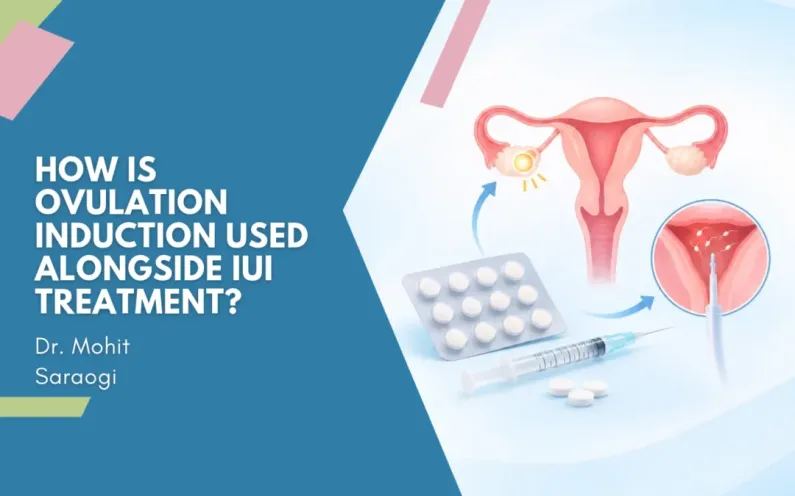
Ovulation induction and IUI often go together in the same cycle. Medicines help one or more eggs mature and release at a predictable time. The doctor then places washed, concentrated sperm directly in the womb right around ovulation.
According to Dr. Mohit Saraogi, IVF Doctor in Mumbai, “Ovulation induction gives us control over timing, and IUI makes sure the sperm are waiting when the egg is released. We choose the medicine and the dose for each woman and track the cycle closely, so only one or two eggs develop.”
Want to know how ovulation induction fits into an IUI cycle?
What Medicines Are Used for Ovulation Induction?
Most women start with simple tablets. Injections come in only if the tablets don’t work. The choice depends on age, cycle pattern and how the ovaries have responded before.
Letrozole: This tablet is taken for 5 days early in the cycle. It’s often the first choice, especially for women with PCOS.
Clomiphene citrate: It’s another tablet that nudges the ovaries to release an egg. Some women get hot flushes or mood changes while taking it.
Gonadotropin injections: These are used when tablets haven’t worked. They contain FSH and need closer monitoring, as they can make more eggs grow.
The trigger shot: This single injection makes the mature egg release, usually 24 to 36 hours later. The IUI is timed around it.
The medicine is only one part of the plan, and our infertility treatment page explains how doctors build the rest of it.
How Does an Ovulation Induction IUI Cycle Work?
The cycle runs in a few clear steps. And timing is what holds them all together.
Day 2 or 3 of the period: A baseline scan checks the ovaries, and the medicines are started.
Follicle monitoring: Scans from about day 9 or 10 track how the follicles are growing. We’re hoping for 1 or 2 mature ones, usually around 18 to 20 mm.
Trigger and IUI: Once the follicles are ready, the trigger shot is given. The IUI follows about 24 to 36 hours later.
The wait: A pregnancy test is done about 2 weeks after the IUI. Some women also take progesterone in the meantime.
Getting the timing right is what makes ovulation induction and IUI work as a pair. Our blog on the trigger shot explains how that injection is used.
Who Benefits From Ovulation Induction With IUI?
It isn’t for everyone. Doctors suggest it when there’s a clear reason, and they also explain what to watch for.
Irregular ovulation or PCOS: If an egg isn’t released every month, the medicines help it happen. IUI then makes sure the sperm are in the right place.
Unexplained infertility: When tests show no clear cause, this combination is a common first step before IVF.
Mild male factor or cervical issues: A slightly low count or thick mucus can slow sperm down. Washing the sample and placing it in the womb helps.
What to watch for: The main risk is twins or more, since several eggs can be released. We scan closely, and we may cancel the cycle if too many follicles grow.
If pregnancy doesn’t happen after a few cycles, the next step may be IVF, which is a separate cycle with its own stimulation and egg retrieval. Our blog on ICSI embryo transfer success rates explains what that involves.
Curious about when doctors choose ovulation induction with IUI?
Frequently Asked Questions
What is ovulation induction in IUI?
It means using medicines to help one or more eggs mature and release on time. The doctor then places washed sperm in the womb around ovulation.
Is ovulation induction always needed with IUI?
No. Women who ovulate regularly can have IUI in a natural cycle. Medicines are added if ovulation is irregular or the doctor wants tighter timing.
What are the side effects of ovulation induction?
Most women have mild effects such as hot flushes, bloating or mood changes. The main risk is twins or more, which is why ultrasound scans track the cycle.
How many IUI cycles with ovulation induction can I try?
Doctors usually advise about 3 to 4 cycles. If there’s no pregnancy by then, they often discuss IVF, since more IUI cycles rarely improve the chances.
References:
- PMC (NIH/NLM): Predictive factors for intrauterine insemination outcomes: a review. https://pmc.ncbi.nlm.nih.gov/articles/PMC7731622/
- PMC (NIH/NLM): Comparing of letrozole versus clomiphene citrate combined with gonadotropins in intrauterine insemination cycles. https://pmc.ncbi.nlm.nih.gov/articles/PMC4163260/
Disclaimer:
This blog is intended for informational purposes only and should not be considered a substitute for professional medical advice, diagnosis, or treatment.