
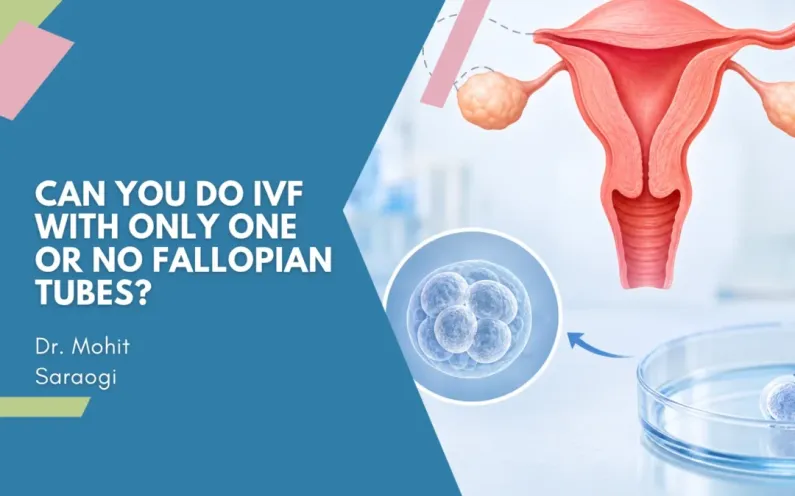
Yes, IVF without fallopian tubes is possible, and so is IVF with just one tube. The eggs are collected straight from the ovaries, fertilised in the lab and placed directly into the womb. So the tubes don’t take part in any of these steps.
According to Dr. Mohit Saraogi, IVF Doctor in Mumbai, “Blocked or missing tubes are one of the most common reasons we advise IVF, and it works well because it bypasses the tubes altogether. What we look at closely is the health of the uterus and whether a damaged tube needs attention first.”
Want to know how IVF works when the fallopian tubes are blocked or missing?
How Does IVF Work Without Fallopian Tubes?
In natural conception, the tubes carry the egg, bring it to the sperm and move the embryo to the womb. IVF takes over every one of those jobs.
Stimulation: Fertility injections help several eggs grow in the ovaries. The ovaries work normally even when the tubes don’t.
Egg retrieval: A fine needle passed through the vagina collects the eggs under ultrasound. No tube is involved at any point.
Fertilisation in the lab: The eggs meet the sperm in the lab, or a single sperm is injected into each egg with ICSI. The embryos then grow for a few days.
Embryo transfer: A thin catheter places the embryo straight into the womb. It’s usually quick and doesn’t need anaesthesia.
For many women, IVF for blocked tubes is the most direct route to pregnancy, and our infertility treatment page explains how the options compare.
When Do Blocked Tubes Need Attention Before IVF?
Missing tubes are fairly straightforward. A blocked tube can be trickier, since some of them can still cause trouble.
Hydrosalpinx: This is a blocked tube filled with fluid. The fluid can leak into the womb and lower the chance of the embryo implanting.
Removal or sealing: Doctors often remove the tube or block it before IVF. Studies show this can improve pregnancy rates in women with a hydrosalpinx.
A blocked tube without fluid: Many of these need no surgery at all. We decide after looking at the scans.
Checking the womb: A scan or hysteroscopy checks the lining for polyps, fibroids or scarring. These are fixed before the embryo transfer.
Blocked tubes are usually found through an HSG, and our blog on what a fertility test panel includes explains how that test works.
Does Having One Tube or None Affect IVF Success?
Success depends far more on egg quality and the womb than on the tubes. Still, a few things deserve attention.
Age and egg reserve: These matter the most. A woman with no tubes but good egg reserve often does as well as anyone else.
The state of the womb: A healthy lining is what lets the embryo settle in. Any fibroids or polyps are treated first.
Ectopic pregnancy: With a damaged tube still in place, an embryo can occasionally implant in the tube. An early scan at about 6 weeks confirms the location of the pregnancy.
Number of embryos transferred: Putting back a single embryo lowers the chance of an ectopic pregnancy.
Sometimes we freeze the embryos and transfer them in a later cycle, once the tube has been treated and the womb is ready. Our frozen embryo transfer page explains how that works.
Curious about how doctors plan IVF when the tubes are damaged?
Frequently Asked Questions
Can you do IVF with only one fallopian tube?
Yes, because IVF doesn’t depend on the tubes. The eggs are collected from the ovaries and the embryo is placed straight into the womb.
Is IVF possible if both tubes are removed or missing?
Yes. IVF is actually the main treatment in this case, as IUI and natural conception need at least one tube that works.
Do blocked tubes need surgery before IVF?
Not always. A tube filled with fluid, called a hydrosalpinx, is often removed or sealed first because it can lower the chance of implantation.
Is ectopic pregnancy still possible after IVF?
Yes, though the risk is small. It is higher when a damaged tube is still present, so an early scan confirms the pregnancy’s location.
References:
- PMC (NIH/NLM): Surgical treatment for tubal disease in women due to undergo in vitro fertilisation. https://pmc.ncbi.nlm.nih.gov/articles/PMC8094448/
- PMC (NIH/NLM): Tubal factor, cleavage stage and more than one embryo transferred were risk factors associated with ectopic pregnancy after assisted reproductive treatment. https://pmc.ncbi.nlm.nih.gov/articles/PMC9118970/
Disclaimer:
This blog is intended for informational purposes only and should not be considered a substitute for professional medical advice, diagnosis, or treatment.