
“IUI is the closest medical alternative to natural conception. It assists your body, not replaces it,” says Dr. Mohit Saraogi, one of Mumbai’s leading IVF and fertility specialists at Saraogi Hospital.
What is a natural pregnancy?
The catch is that several things must go right at the same time. Ovulation has to happen regularly. The fallopian tubes must be clear. The uterine lining has to be ready. Sperm count, motility, and shape must be in a healthy range. And the timing of intercourse must line up with the fertile window, which is only a few days each cycle. Most healthy couples manage to conceive within six to twelve months of trying. Some take longer, and that is where things start to feel stressful.
What Is IUI (Intrauterine Insemination)?

Couples opting for IUI Treatment in Mumbai usually get a mix of ovulation tracking, mild stimulation medicines, and one or two timed inseminations during a single cycle. IUI tends to suit specific situations. Mild male-factor issues. Unexplained infertility, which is more common than people realise. Cervical mucus problems. Ovulation issues like PCOS. It also works well for couples using donor sperm and for single women who want to start a family on their own.
In short, IUI is the first medical step when natural attempts have not worked but IVF is not yet on the table.
Key Differences Between IUI and Natural Pregnancy
| Feature | Natural Pregnancy | IUI (Intrauterine Insemination) |
| Where fertilisation happens | Fallopian tube | Fallopian tube (sperm placed in uterus first) |
| Doctor involved | No | Yes |
| Ovulation tracking | Not needed | Done with scans and hormone tests |
| Sperm preparation | None | Washed and concentrated in a lab |
| Medicines | None | Often used (Clomid, Letrozole, gonadotropins) |
| Per-cycle success | 15% to 25% under 35 | 10% to 20% per cycle |
| Cost in India | Free | Roughly ₹8,000 to ₹25,000 per cycle |
| Best suited for | Healthy couples | Mild infertility, donor sperm, single women |
| Time to result | 6 to 12 months on average | 3 to 6 cycles suggested |
| How invasive | Not at all | Minimally invasive |
IUI is the gentlest step up from natural conception. It is not a leap. For many couples, this is where their fertility journey begins, and quite often, where it ends with a positive test.
How Does the IUI Procedure Work?

Then the actual insemination happens. A thin catheter, similar to one used for a Pap smear, carries the sperm into the uterus. It is over in five to ten minutes. No anaesthesia. No hospital stay. Most women walk out and go about their day. Two weeks later, a blood test confirms whether the cycle worked.
Success Rates: IUI vs Natural Pregnancy
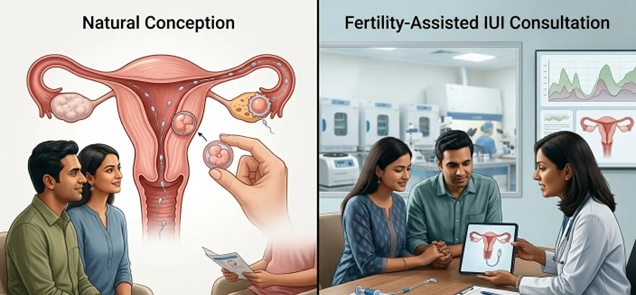
For natural pregnancy, women under 30 have about a 20% to 25% chance per cycle. The numbers slide gradually after that. Around 15% to 20% from 30 to 34. Roughly 10% to 15% from 35 to 37. About 5% to 10% from 38 to 40. After 40, it drops below 5% per cycle.
IUI shows a similar age curve, with one notable advantage. It tends to deliver more steady results when there is an existing fertility issue. Women under 35 see about 15% to 20% per cycle. Between 35 and 37, it is 10% to 15%. From 38 to 40, around 8% to 10%. Above 40, only 2% to 5%. The bigger story is the cumulative number. After three to six cycles, the total success rate can reach 40% to 50% in women under 35. If pregnancy has not happened by the fourth cycle, doctors usually start a conversation about IVF or ICSI.
When Should You Switch from Natural Conception to IUI?
Waiting too long is the most common mistake. Time is the one thing fertility care cannot give back. Comprehensive Infertility Treatment in Mumbai at Saraogi Hospital usually starts with a proper workup. Hormone panels, ultrasounds, semen analysis, and a discussion about what makes sense next. Sometimes the answer is to keep trying naturally for a few more months. Sometimes it is to start IUI right away. Either way, you have a plan.
Risks and Considerations
Natural pregnancy has no medical risks of its own. But for couples who already know something is off, “just keep trying” can quietly cost months that would have been better spent on a real plan.
Conclusion
At Saraogi Hospital, we keep it practical. Good diagnostics, personalised IUI protocols, and a team that explains every step. For a fuller picture of how IUI compares with other fertility treatments, take a look at our guide on IVF vs ICSI vs IMSI: Which Is Right?.
Frequently Asked Questions
Q1: Is IUI better than trying to conceive naturally?
Q2: How many IUI cycles should I try before moving to IVF?
Q3: Does IUI hurt or require anaesthesia?
Q4: What is the cost of IUI in India in 2026?
Q5: Can twins or multiple pregnancies happen with IUI?
- Cleveland Clinic – Intrauterine Insemination (IUI): https://my.clevelandclinic.org/health/treatments/22456-iui-intrauterine-insemination
- Mayo Clinic – Intrauterine Insemination: https://www.mayoclinic.org/tests-procedures/intrauterine-insemination/about/pac-20384722
- NCBI – Intrauterine Insemination Outcomes Review: https://www.ncbi.nlm.nih.gov/books/NBK539859/
- ICMR – Indian Council of Medical Research: https://www.icmr.gov.in/
Disclaimer: The content shared on this page is for informational purposes and not for promotional use.