
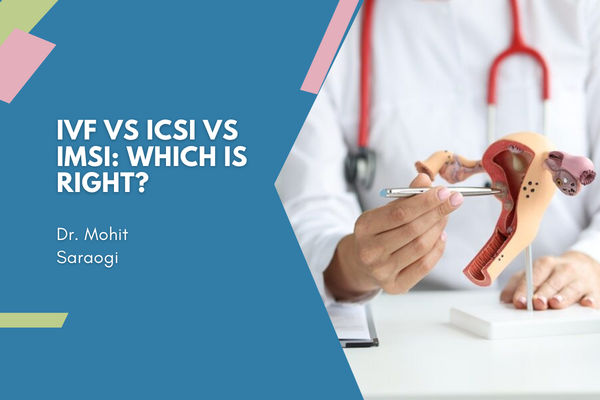
IVF suits female-factor infertility with normal sperm, ICSI suits male-factor infertility or low fertilisation in previous IVF, and IMSI suits severe male-factor cases with poor sperm morphology or high DNA fragmentation. The core decision depends on semen quality and any past fertilisation history.
According to Dr. Mohit Saraogi, an experienced IVF specialist at Saraogi Hospital, couples often shop between clinics for the “highest technology” option without understanding the clinical indication, “picking IMSI when you don’t need it won’t improve your odds, and picking regular IVF when you actually need ICSI can cost you a cycle. The treatment has to match the diagnosis, not the marketing.”
Unsure which of the three fits your diagnosis best?
IVF vs ICSI vs IMSI: Side-by-Side Comparison
All three treatments look nearly identical until the eggs reach the lab, and that’s where the decision actually matters for outcomes.
| Parameter | IVF | ICSI | IMSI |
| Fertilisation method | Sperm fertilises egg on its own in a culture dish | One sperm injected directly into the egg | Same as ICSI, with high-magnification sperm selection first |
| Magnification used | None | 200x | 6,000x to 10,000x |
| Best suited for | Female-factor infertility with normal sperm | Male-factor infertility or previous low fertilisation | Severe male-factor, high DNA fragmentation, recurrent ICSI failure |
| Fertilisation rate | 60 to 70 percent with normal sperm | 70 to 80 percent across sperm profiles | Similar to ICSI with better embryo quality in selected cases |
| Cost range (India) | ₹90,000 to ₹1,50,000 | ₹1,20,000 to ₹2,00,000 | ₹2,00,000 to ₹3,50,000 |
The instinct to pick the most expensive option almost never pays off in fertility treatment, and a proper infertility treatment workup lines the protocol up with the actual diagnosis rather than the price tag.
How Do I Decide Which One Suits My Diagnosis?
What most couples miss is that the choice between these three is a clinical one, decided off lab reports, previous cycle outcomes, and semen parameters, not whichever treatment sounds more advanced to the ear.
- Semen: Men with sperm concentration below 15 million per ml, motility under 40 percent, or strict-criteria abnormal morphology above 96 percent are rarely good candidates for standard IVF, and ICSI treatment is where most of these couples eventually land as a first-line protocol.
- Fertilisation: When a couple’s previous IVF cycle returned fertilisation rates under 30 percent despite a normal-looking semen report, the problem is rarely the lab environment itself, it’s the sperm-egg interaction, and the next cycle almost always moves to ICSI on that basis.
- DNA damage: Sperm DNA fragmentation index crossing 30 percent, two or three early miscarriages in a row, or a couple of failed ICSI cycles with textbook embryos are the clinical triggers that push a treating team toward IMSI, which filters out sperm that standard ICSI would have passed as healthy.
- Female factor: For tubal blockage, endometriosis, advanced maternal age with a healthy partner semen report, or plain unexplained infertility, standard IVF usually delivers results on par with ICSI, and spending on IMSI here just inflates the bill without adding any real clinical value.
Protocol shifts between cycles aren’t unusual at all for the same couple, and this is also why post-transfer signals such as bleeding after IVF get read so carefully alongside the semen report before the next plan is locked.
Why Choose Saraogi Hospital?
Saraogi Hospital runs a 40-year-old reproductive medicine unit under one roof, with in-house embryology handling standard IVF alongside ICSI and high-magnification IMSI, sperm DNA fragmentation testing built into the regular male-factor workup, andrology reviewed in parallel with every female-factor evaluation, and Dr. Mohit Saraogi along with Dr. Roopa Prasad leading a team that tends to match the protocol to the actual clinical picture rather than the one that looks most premium on paper, which is why couples already comparing IVF, ICSI, and IMSI across three or four clinics usually come here for a final clinical opinion before making the call.
Frequently Asked Questions
What is the main difference between IVF and ICSI?
IVF lets sperm fertilise the egg naturally in a dish, while ICSI injects one selected sperm directly into the egg.
When is IMSI preferred over ICSI?
IMSI is preferred for severe male-factor infertility, high sperm DNA fragmentation, or two or more failed ICSI cycles.
Is ICSI always better than normal IVF?
ICSI is only better when sperm quality is poor or fertilisation has previously been low, otherwise IVF works equally well.
Does IMSI guarantee a successful pregnancy?
IMSI improves sperm selection accuracy but success still depends on embryo quality, uterine receptivity, and overall health.
References:
- National Institutes of Health — ICSI vs conventional IVF outcomes
- World Health Organization — Infertility overview
