

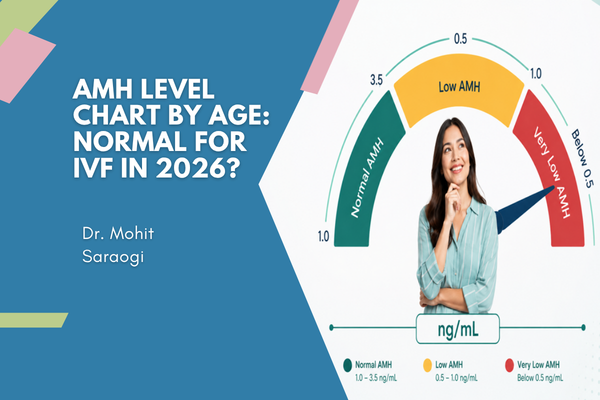
AMH measures ovarian reserve and declines with age,but it says nothing about egg quality or pregnancy likelihood.What it does tell your fertility specialist is how your ovaries will respond to stimulation drugs and what medication dosage your cycle needs to start on the right footing.
According to Dr. Mohit Saraogi, a leading ivf doctor in mumbai at Saraogi Hospital, “AMH without an age reference is a number without a story, because a result that looks reassuring at 28 can mean something very different for a woman who is 39.”
Know what your AMH level means for IVF—book a fertility consultation today.
What Does a Normal AMH Level Look Like at Each Age?
Most patients Google their AMH result and compare it to a single universal range. That’s the wrong approach. Here’s what the numbers actually mean when age is factored in.
- Under 25: Peak reserve years. AMH typically sits between 3.0 and 6.8 ng/mL, and anything above that upper limit needs a closer look for PCOS rather than being treated as a straightforwardly good sign.
- Ages 25 to 30: Expected range is 2.5 to 5.0 ng/mL. Most women here respond predictably to standard stimulation and don’t need protocol modification, which is why fertility specialists often describe this window as the most straightforward to work with.
- Ages 31 to 35: Normal sits between 1.5 and 3.5 ng/mL but decline starts accelerating for some women in this group, and the difference between a result at 31 and one at 35 can be significant enough that waiting even a year before testing changes what you’re working with.
- Ages 36 to 40: Range drops to 0.5 to 2.5 ng/mL. Results at the lower end don’t close the door on IVF but they do change how stimulation gets approached, what retrieval targets look realistic and how the overall cycle plan gets structured around what your ovaries can actually deliver.
If your number sits outside these ranges for your age, an infertility teratment with antral follicle count and full hormonal panel gives a far more complete picture than AMH alone.
What Happens When Your AMH Is Low for Your Age?
Low AMH relative to your age group changes the plan. It doesn’t end it. But the clinical response depends on factors that go well beyond the number on your report.
- Stimulation approach: Higher gonadotropin doses and closer monitoring become the norm for low-AMH patients, and the goal isn’t maximum egg numbers anymore. It shifts to retrieving the best quality eggs your ovaries can produce within a protocol that doesn’t push a limited reserve harder than it can handle.
- Mild stimulation: For women significantly below the age-expected range, lower medication doses over a longer cycle window sometimes produce fewer but better-graded embryos. Aggressive stimulation on a depleted reserve often retrieves more eggs that are poorer quality, which isn’t the trade-off most patients expect.
- Banking across cycles: When AMH is low but age is still on your side, accumulating embryos across two or three retrieval cycles before any transfer can build a viable pool without the pressure of a single attempt having to deliver everything.
- Donor egg pathway: Women over 40 with AMH below 0.3 ng/mL will sometimes be counselled toward donor eggs, but that conversation never happens on AMH alone. Antral follicle count, previous stimulation response and what the patient actually wants all shape where that discussion goes.
Our earlier blog on improving egg quality before IVF covers what you can do in the weeks before retrieval to make the most of the reserve you have.
Why Choose Saraogi Hospital?
Dr. Mohit Saraogi has 13 years across gynaecology, obstetrics and clinical embryology, more than 18,000 patients treated at IRIS IVF Centre, a success rate above 70% for women under 35, and a track record that includes patients whose AMH sat well below the expected range for their age when they first came in.
What patients consistently mention is that their AMH result doesn’t arrive with a generic prognosis attached. It gets read alongside age, antral follicle count and cycle history before anything gets decided, so the consultation ends with a plan, not just a number.
Check your AMH and plan your IVF journey with expert guidance.
Frequently Asked Questions
What is a normal AMH level for a 30-year-old?
Between 2.5 and 5.0 ng/mL is considered normal for women aged 25 to 30.
Can I do IVF with low AMH for my age?
Yes. Low AMH changes the stimulation protocol but doesn’t prevent IVF in most cases.
At what AMH level should I consider donor eggs?
Women over 40 with AMH below 0.3 ng/mL may be counselled toward donor eggs after full evaluation.
Does AMH decline faster after 35?
Yes. AMH decline accelerates noticeably between 35 and 40 for most women.
References:
- AMH as a Marker of Ovarian Reserve — NIH / PubMed
- Age-Related Decline in Female Fertility — NIH / PubMed
