
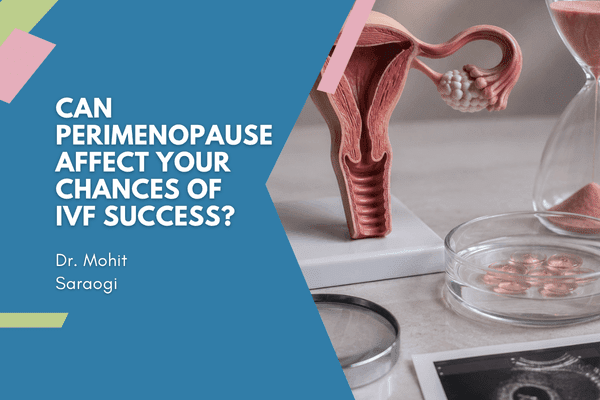
Perimenopause changes the odds of IVF success when using your own eggs. Ovarian reserve declines, hormone levels fluctuate, and chromosomal abnormalities in the remaining eggs become more common during this transition. These shifts make conception with your own eggs considerably harder in the perimenopausal years. Donor eggs, however, restore success rates to a level much closer to what younger patients see.
According to Dr. Mohit Saraogi, one of the Best IVF Doctor in Mumbai at Saraogi Hospital, “Patients often assume perimenopause means periods have already stopped. It doesn’t. Cycles can still be regular while egg quality is already declining underneath. That gap between what a woman feels and what her ovaries are actually doing is where most of the confusion comes from.”
Noticing irregular cycles and wondering how it affects your IVF plans? Get a proper fertility assessment before deciding your next step.
How Does Perimenopause Affect IVF With Your Own Eggs?
Perimenopause isn’t a single switch. It’s a gradual shift across several fronts at once.
- Ovarian reserve: Both egg count and egg quality drop during this transition, sometimes years before periods become irregular. Fewer eggs retrieved usually means fewer viable embryos.
- Hormonal fluctuation: FSH and AMH levels swing unpredictably during perimenopause, which makes stimulation protocols harder to plan and monitor precisely.
- Chromosomal abnormalities: Eggs retrieved during this phase carry a higher rate of chromosomal errors. This raises both miscarriage risk and the odds of a failed implantation.
- Response to stimulation: Ovaries respond less predictably to fertility medication during perimenopause, and cycles sometimes get cancelled before retrieval for this exact reason.
So when own-egg IVF success drops meaningfully, egg donation treatment becomes a realistic path that restores success rates closer to what younger patients typically see.
When Should You Get Evaluated for Perimenopause Before IVF?
Waiting for symptoms to appear can cost valuable time. Testing early gives more clarity, and more options.
- AMH and FSH testing: These blood markers give an early read on ovarian reserve, often before any noticeable change in cycle regularity.
- Antral follicle count: An ultrasound-based count of visible follicles adds a second data point alongside blood work, since hormone levels alone can be misleading.
- Cycle tracking: Shortening or lengthening cycles, even mild ones, are worth mentioning during a fertility consult. Patients often dismiss this as normal aging.
- Family history: Because early menopause tends to run in families, a mother or sister’s history is a useful clue worth raising early.
Curious how this connects to earlier-than-expected menopause? Our blog on menopause before 40 covers the causes and warning signs in more depth.
Why Choose Saraogi Hospital?
Dr. Mohit Saraogi brings thirteen years across gynaecology, obstetrics, and clinical embryology to fertility cases involving perimenopause. He has treated over 18,000 patients at IRIS IVF Centre, with success rates above 70% for women under 35. Every perimenopausal patient gets a full ovarian reserve workup before a protocol is decided, since assuming a standard stimulation plan will work the same way here often leads to disappointment. Own-egg IVF, donor egg IVF, or a modified protocol, the recommendation depends entirely on the numbers from that workup.
Patients sometimes push for repeated own-egg cycles even after results suggest otherwise, mostly out of hope rather than clinical logic. An honest conversation about the numbers, sooner rather than later, tends to save both time and money. Call +91 81697 17250 to get your ovarian reserve evaluated properly.
Not sure if your cycle changes point to perimenopause? An AMH and FSH test gives a clear answer in one visit.
Frequently Asked Questions
Does perimenopause reduce IVF success rates?
Yes, it lowers success with your own eggs due to declining reserve and quality.
How is perimenopause confirmed before an IVF cycle?
AMH, FSH, and antral follicle count together give the clearest picture.
Can donor eggs improve IVF success during perimenopause?
Yes, donor egg IVF largely bypasses the egg quality decline perimenopause causes.
Can perimenopause affect fertility before periods stop?
Often, yes, since egg quality drops years before periods actually stop.
Disclaimer:
This blog is intended for informational purposes only and should not be considered a substitute for professional medical advice, diagnosis, or treatment.