

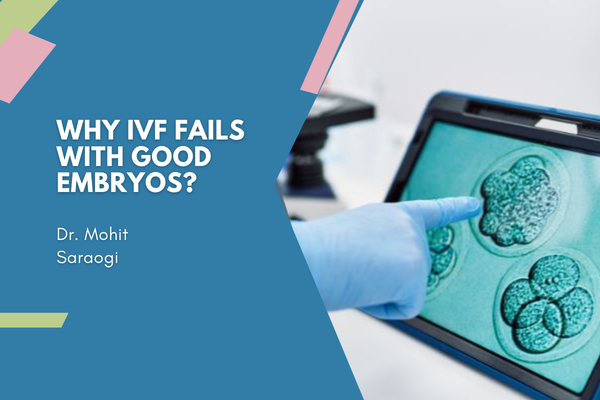
IVF can fail even with good quality embryos because embryo grade alone doesn’t decide pregnancy. Success depends on uterine receptivity, endometrial thickness, immune response, hidden chromosomal defects, progesterone levels, and sperm DNA fragmentation. In about 30 to 50 percent of failed cycles with top-grade embryos, the root cause lies outside the embryo itself. Testing the uterine environment, hormonal balance, and immune markers is often what turns a failed cycle into a successful one.
According to Dr. Mohit Saraogi, an experienced IVF specialist at Saraogi Hospital, couples often blame the embryo when a cycle fails, “but in reality the embryo is just one side of the equation. A grade-A blastocyst can still fail if the uterus isn’t ready to receive it, and that’s where most unexplained IVF failures actually sit.”
Had a failed IVF cycle despite good embryos?
What Are the Main Reasons IVF Fails With Good Quality Embryos?
Most couples assume grading tells the full story of embryo quality, when all it really captures is how the cells look on a screen, not whether the genetic code inside them is intact.
- Chromosomes: A blastocyst can grade beautifully on day 5 and still carry a chromosomal error nobody catches by eye, which is usually the hidden reason behind the frustrating pattern where the embryo looks perfect but the pregnancy never takes hold, and PGT-A testing catches this but most clinics offer it only after two cycles have already failed.
- Endometrium: The uterine lining is rarely given the attention it deserves during the first IVF cycle, even though it can refuse a perfectly healthy embryo on its own, with thickness below 7mm being the obvious warning sign while poor sub-endometrial blood flow and a shifted receptivity window cause a lot of silent losses that are never investigated in time.
- Sperm DNA: Fertilisation can look absolutely normal on day one and still fall apart by day three when paternal DNA is heavily fragmented, something a standard semen analysis report never flags, which ends up being the hidden variable that explains years of unexplained cycle failures for many couples before anyone thinks to test it.
- Hormones: Progesterone coverage, the exact timing of the trigger injection, and estrogen stability decide whether the uterus is biologically ready for the embryo on transfer day, and when any one of those drifts off protocol the embryo essentially lands in a closed receptivity window instead of an open one.
Blaming the embryo first is the instinct, though in practice a proper infertility treatment review almost always finds the real answer somewhere around it, not inside it.
What Other Factors Cause Repeated IVF Failure?
By the time a couple hits two failures with good embryos, something systemic is almost always in play, and continuing to blame the lab report at that stage just wastes another cycle’s worth of time and money.
- Immune: An overactive maternal immune response can mistake the embryo for a foreign threat and work against it, with raised natural killer cell counts, thyroid antibodies, and clotting disorders like APLA being the usual suspects, yet most couples only get tested for these after three back-to-back failures instead of earlier.
- Infection: Silent endometritis is probably the most underdiagnosed reason behind repeated IVF failure in India, because there are no symptoms, no pain, and nothing that shows up on a routine scan, yet until a targeted biopsy catches it cycles keep failing regardless of whether the patient goes for regular IVF or ICSI treatment after that.
- Transfer: Something as technical as the angle of the catheter or how full the bladder is at transfer time can push the embryo to a spot in the uterus that isn’t ideal for implantation, and these small imperfect decisions add up invisibly across a full cycle in ways that are very hard to audit later.
- Lifestyle: Everyday things patients rarely associate with IVF success, uncontrolled diabetes, an unstable thyroid, a high BMI, occasional smoking, months of poor sleep and chronic stress, quietly erode implantation rates and almost never feature in the first conversation until repeated results force them onto the table.
Recurrent implantation failure behaves nothing like a first-attempt cycle and needs its own investigation plan, in the same way bleeding after IVF has to be read very differently from expected post-transfer spotting.
Why Choose Saraogi Hospital?
Saraogi Hospital brings 40 years of reproductive medicine into a single clinical framework, with a 70 percent plus success rate in women under 35, in-house PGT-A, ERA and EndomeTRIO workups for endometrial receptivity, dedicated immune and thrombophilia panels for repeated failure cases, and a clinical lead of Dr. Mohit Saraogi along with Dr. Roopa Prasad heading a team that builds every second-opinion protocol around the actual reason a previous cycle failed rather than running the same plan again, which is why couples with two or three unsuccessful attempts elsewhere come here for a fresh clinical read.
Frequently Asked Questions
Can an IVF cycle fail even with a grade A embryo?
Grade A embryos can still fail due to chromosomal defects, thin uterine lining, immune rejection, or low progesterone support.
How many failed IVF cycles before further testing?
Most specialists advise deeper testing like PGT-A, ERA, and immune panels after two failed cycles with good embryos.
Does sperm quality affect IVF success with good embryos?
High sperm DNA fragmentation can cause embryo arrest after day 3, even when the initial grading appears normal.
Is repeated IVF failure always due to the embryo?
Most repeated failures trace back to endometrial, immune, hormonal, or lifestyle factors rather than the embryo itself.
References:
- National Institutes of Health — Repeated implantation failure in IVF
- World Health Organization — Infertility overview
