
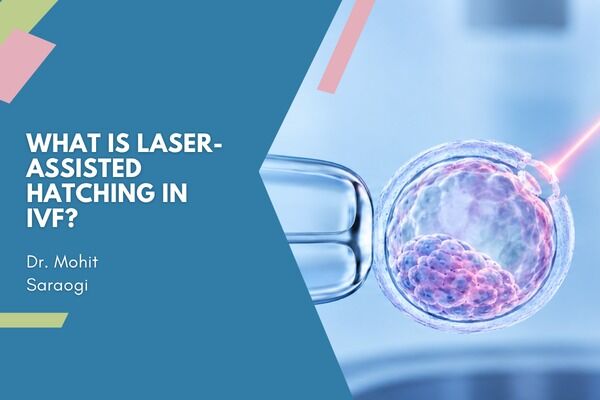
Laser assisted hatching is a laboratory procedure used during IVF to help an embryo break out of its protective outer shell, the zona pellucida. An infrared laser makes a tiny opening in the shell or thins it, which can make implantation in the womb lining easier. It takes place in the embryology lab and never inside the body.
According to Dr. Mohit Saraogi, IVF Doctor in Mumbai, “Laser assisted hatching is a precise step that takes only seconds under the microscope. The real skill lies in knowing which embryos will benefit from it. That is why we recommend it only when there is a clear clinical reason and never as a routine.”
Want to know where laser assisted hatching fits in the timeline of an IVF cycle?
How Does Laser Assisted Hatching Work?
To attach to the womb lining, an embryo first has to get out of its shell. Some shells are thicker or tougher than usual, and that’s where assisted hatching can lend a hand.
The zona pellucida: That shell is the zona pellucida, a protective layer around the egg and early embryo. A healthy embryo usually works its way out by day 5 or 6 without any help.
The laser step: Under the microscope the embryologist uses a fine infrared laser to open or thin a small patch of the shell. The whole thing takes seconds, and the laser never touches the embryo itself.
The timing: Most clinics do it on a day 3 or day 5 embryo just before transfer. In a frozen cycle it is done on the thawed embryo instead.
After the procedure: The embryo is transferred soon afterwards and the rest of the cycle carries on exactly as it would have anyway.
Hatching is one small lab step in a full cycle, and our IVF treatment page walks through the rest.
Who May Benefit From Assisted Hatching?
It isn’t a routine step. In practice it is kept for a few situations where the shell could genuinely be in the way.
Women over 37: Eggs from older women tend to have a thicker and harder shell, and that can make it tougher for the embryo to break out.
Repeated failed transfers: If good embryos haven’t implanted in earlier cycles, the shell is sometimes one of the things we look at.
Thawed embryos: Freezing and thawing can harden the shell as well, so hatching comes up more often in frozen cycles.
A visibly thick shell: And occasionally the embryologist just spots an unusually thick or tough shell under the microscope.
When embryos keep failing to implant, timing is another thing we check. Our blog on the ERA test explains how that is done.
What Are the Risks and Limits of Laser Assisted Hatching?
On paper it looks like an easy win, though the evidence is more mixed than most people expect. A few honest points are worth knowing first.
The evidence is mixed: Large reviews haven’t found a clear rise in live birth rates for everyone, and that’s why we use it selectively.
A small risk to the embryo: Any lab handling carries a small chance of harming the embryo. In skilled hands the laser is considered safe.
A possible twin risk: Some studies have linked the procedure to a slightly higher chance of identical twins.
An extra cost: It’s usually billed on top of the cycle, and it’s fair to ask the clinic exactly what the fee covers.
The question comes up most often in a frozen embryo transfer cycle, since freezing can harden the shell, so that’s a good time to raise it.
Key Takeaways : Laser assisted hatching opens or thins the embryo’s outer shell so it can break out and implant. It tends to be kept for selected cases, for example older women, repeated failed transfers or thawed embryos. The evidence for wider use is still mixed, so it is best discussed with your doctor
Want to understand when doctors consider hatching for an embryo transfer?
Frequently Asked Questions
What is laser assisted hatching?
It’s a lab step where a laser makes a tiny opening in or thins the embryo’s outer shell. This helps the embryo break out and attach to the womb.
Is laser assisted hatching painful?
No, because it is done on the embryo in the lab and not on your body. You won’t feel it, and the embryo transfer itself feels no different.
Does laser assisted hatching improve success rates?
It may help in selected cases such as older women or thawed embryos. Overall the results are mixed, so it isn’t advised for everyone.
Is laser assisted hatching safe for the embryo?
In experienced hands it is considered safe, as the laser doesn’t touch the embryo directly. A small risk of embryo damage still exists, as with any lab handling.
References:
- PMC (NIH/NLM) — Assisted hatching on assisted conception (in vitro fertilisation (IVF) and intracytoplasmic sperm injection (ICSI)): https://pmc.ncbi.nlm.nih.gov/articles/PMC8094760/
- PMC (NIH/NLM) — The effects of laser assisted hatching on pregnancy rates: https://pmc.ncbi.nlm.nih.gov/articles/PMC4216442/
Disclaimer:
This blog is intended for informational purposes only and should not be considered a substitute for professional medical advice, diagnosis, or treatment.