
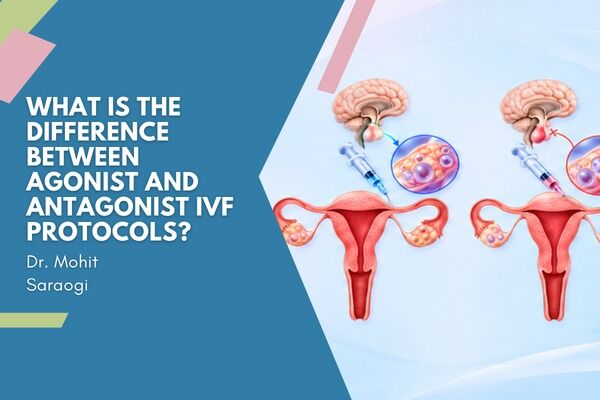
Both agonist and antagonist IVF protocols exist to stop one thing, an LH surge that arrives too early and releases the eggs before they can be collected. What separates them is how they handle the pituitary gland, the part of the brain that controls that surge.
According to Dr. Mohit Saraogi, IVF Doctor in Mumbai, “Neither protocol is better in every case. We choose based on your age, ovarian reserve and how you responded in earlier cycles. The aim is the same in both, which is to collect good eggs at the right time without an early ovulation.”
Want to understand how doctors choose between IVF protocols for different patients?
How Do Agonist and Antagonist IVF Protocols Work?
IVF protocols are simply the plan for which medicines are used and when. Agonist and antagonist plans differ mainly in how they keep the body’s own hormone surge under control.
The shared goal: Whichever route is taken, the pituitary has to be kept from sending out LH too early. If it isn’t, the eggs can be released before anyone gets the chance to collect them.
The agonist route: The medicine first gives the pituitary a short push and then quietens it completely, which takes 1 to 2 weeks. Stimulation injections begin only after that suppression is in place.
The antagonist route: Stimulation injections start early in the cycle and a blocker is added a few days later, usually around day 5 or 6. It stops the LH surge straight away.
The common names: The agonist approach is often called the long protocol and the antagonist approach the short protocol, because of how long each cycle runs.
Both routes lead to the same next step, egg retrieval and fertilisation in the lab, which our IVF treatment page walks through.
How Do Agonist vs Antagonist IVF Protocols Compare?
Put side by side, agonist vs antagonist IVF shows its real differences in the length of the cycle, the number of injections and the risk of side effects.
| Point of comparison | Agonist protocol (long) | Antagonist protocol (short) |
| Length of the cycle | Often 3 to 4 weeks from the first medicine to retrieval | Usually about 2 weeks |
| Number of injections | More days of injections, since suppression comes first | Generally fewer days of injections overall |
| OHSS risk | Higher, especially in women with PCOS or many follicles | Lower, since a gentler trigger shot can be used |
| Side effects | Hot flushes, headaches and mood swings from the temporary shutdown | Tend to be milder |
If you are preparing for a cycle, our blog on how to improve egg quality before IVF in 30 days covers what you can do beforehand.
Which IVF Protocol Is Right for You?
Live birth rates are often similar across the two protocols. So it makes more sense to ask which one fits your body than which one wins.
Age and ovarian reserve: AMH and the antral follicle count tell the doctor roughly how well the ovaries are likely to respond, and that shapes the first choice.
Past response: If an earlier cycle gave very few eggs or far too many, the next plan is usually adjusted around that.
Risk of OHSS: PCOS or a high AMH often points towards the antagonist route because of its safety advantage.
Planning and schedule: The agonist protocol needs more planning because it starts in the cycle before. The antagonist protocol is easier to fit in at short notice.
Whichever protocol is chosen, daily habits still count. Our blog on what foods to avoid during IVF stimulation is worth a read before you begin.
Key Takeaways : Agonist and antagonist protocols both stop an early LH surge, just in different ways. The antagonist cycle is shorter and gentler on the ovaries, whereas the agonist cycle gives longer and tighter control. No single one suits everybody, so your age, ovarian reserve and past response decide which route makes sense.
Wondering which IVF protocol your own test results might point towards?
Frequently Asked Questions
What is the main difference between agonist and antagonist IVF protocols?
An agonist switches the pituitary off before stimulation starts, while an antagonist blocks the surge only when it’s needed. That one difference shapes how long the cycle runs.
Which IVF protocol is better, agonist or antagonist?
Neither wins across the board. Live birth rates are often close, so the doctor looks at your age, ovarian reserve and how earlier cycles went.
Is the antagonist protocol shorter?
Generally yes. An antagonist cycle runs about 2 weeks from the first injection to retrieval, while an agonist cycle can stretch to 3 or 4 weeks.
Does the choice of protocol affect OHSS risk?
Yes, it can. The antagonist route carries a lower risk, mainly because it allows a gentler trigger shot, so women with PCOS are often offered it.
References:
- PMC (NIH/NLM) — GnRH agonist versus GnRH antagonist in in vitro fertilization and embryo transfer (IVF/ET): https://pmc.ncbi.nlm.nih.gov/articles/PMC3442989/
- PMC (NIH/NLM) — Comparisons of GnRH Antagonist versus GnRH Agonist Protocol in Supposed Normal Ovarian Responders Undergoing IVF: A Systematic Review and Meta-Analysis: https://pmc.ncbi.nlm.nih.gov/articles/PMC4162565/
Disclaimer:
This blog is intended for informational purposes only and should not be considered a substitute for professional medical advice, diagnosis, or treatment.