
Successful Twin Pregnancy After Recurrent IVF Failure with Donor Egg IVF
This is a case of twin pregnancy after recurrent IVF failure, involving a 34-year-old woman and her 35-year-old husband who came to Saraogi Hospital in October 2025 following three unsuccessful IVF cycles elsewhere. Twice, her egg retrieval had ended in empty follicle syndrome, where follicles appeared healthy on scan but no eggs were retrieved. A donor egg transfer at another clinic had also failed. Dr. Mohit R. Saraogi identified a raised sperm DNA fragmentation index in the husband and, later, a uterine septum in the wife. Following testicular sperm extraction, a donor egg IVF cycle, and hysteroscopic septum correction, the couple conceived twins. The pregnancy was carried to 34 weeks despite hypertensive complications, and both babies were delivered safely.
PATIENT PROFILE
| AGE | 34 years (wife), 35 years (husband) |
| GENDER | Female |
| PRESENTING COMPLAINT | Recurrent IVF failure, twice-repeated empty follicle syndrome, one failed donor egg transfer elsewhere |
| DIAGNOSIS | Empty follicle syndrome (recurrent), raised sperm DNA fragmentation index, uterine septum |
| DATE OF PROCEDURE | October 2025 to delivery |
| OUTCOME | Healthy twin delivery at 34 weeks |
THE PROBLEM: RECURRENT IVF FAILURE AND EMPTY FOLLICLE SYNDROME
By the time this couple reached Saraogi Hospital in October 2025, they had already completed three IVF cycles elsewhere. The first attempt ended before egg collection could yield any result: after fifteen days of stimulation, with follicles appearing to grow normally on scan, the pickup retrieved no oocytes at all. This outcome, known as empty follicle syndrome, is uncommon and can be difficult to explain even after detailed review.
A second cycle followed, with a modified stimulation protocol. Three oocytes were retrieved from multiple follicles, and one embryo was formed. The resulting transfer failed. A third pickup was then attempted, and empty follicle syndrome recurred. The couple was counselled toward donor eggs and underwent one donor egg transfer at another centre, which also failed.
Three failed egg pickups, one failed embryo transfer, and one failed donor cycle later, the couple sought further evaluation at Saraogi Hospital.
CONSULTATION AND TREATMENT PLAN
WHAT WAS ASSESSED DURING THE CONSULTATION
Dr. Mohit R. Saraogi conducted a fresh evaluation rather than repeating the prior protocol. The husband’s semen analysis was largely normal, though motility was mildly reduced, with normal sperm forms at 3%, against an expected 4%. Sperm DNA fragmentation testing (DFI) returned a mildly elevated result. The full history of the three prior IVF cycles and the failed donor transfer was reviewed in detail, and the recurrence of empty follicle syndrome was identified as a central factor guiding the treatment plan.
WHY THIS TREATMENT APPROACH WAS CHOSEN
Given two documented episodes of empty follicle syndrome, donor egg IVF was recommended over a further self-egg cycle. Because the sperm DNA fragmentation index was raised, testicular sperm extraction (TESA) was advised, as sperm retrieved directly from testicular tissue typically shows lower DNA fragmentation than ejaculated sperm. A donor egg IVF cycle combined with TESA-derived sperm was planned to address both the oocyte-related and sperm-related factors identified during evaluation. When the first donor egg transfer failed despite a favourable endometrial lining, hysteroscopy was added to the plan to rule out an undetected uterine cause.
PROCEDURE ILLUSTRATION
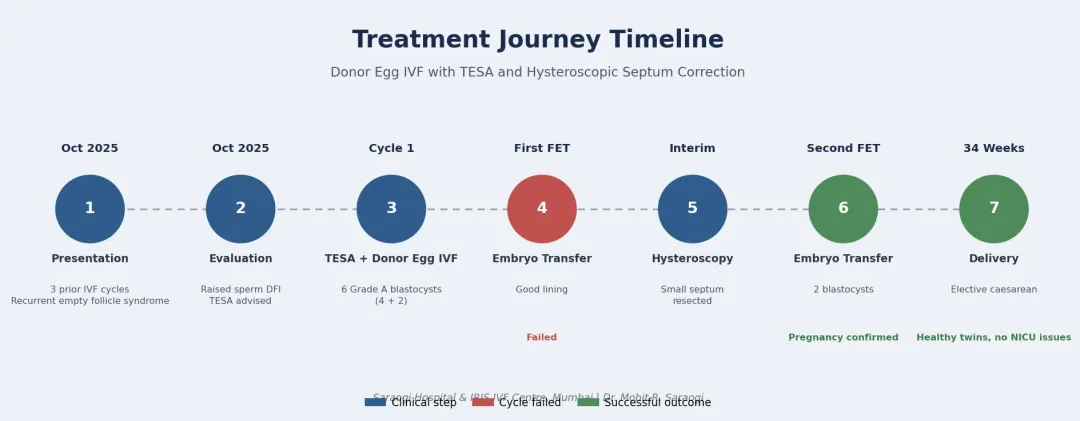
The patient underwent testicular sperm extraction combined with a donor egg IVF cycle, followed by hysteroscopic correction of a uterine septum before the second frozen embryo transfer. The illustration below outlines the standard IVF workflow followed in this case, from egg retrieval and fertilisation through to embryo development and transfer, adapted here to use donor oocytes and surgically retrieved sperm.

PROCEDURE DETAILS
- Testicular sperm extraction performed due to the raised sperm DNA fragmentation index
- Donor egg IVF cycle carried out using the TESA-derived sperm sample, fertilised via ICSI, as required for surgically retrieved sperm
- Fertilisation resulted in six Grade A, day-5 blastocysts (4 plus 2)
- First embryo transfer performed with a satisfactory endometrial lining; the cycle was unsuccessful
- Hysteroscopy performed to investigate the failed transfer, revealing a small uterine septum, which was resected
- One-month recovery period observed before the next transfer
- Second frozen embryo transfer performed with two blastocysts; the patient conceived with twins
- Blood pressure began rising around 12 weeks of pregnancy, requiring full-dose antihypertensive management
- Cervical cerclage placed as part of high-risk pregnancy management
- Hospital admission at 24 weeks for blood in vomitus, and again at 32 weeks for uncontrolled blood pressure with associated headache
- Pregnancy conserved to 34 weeks despite these complications
- Delivery carried out via elective caesarean section on full-dose antihypertensive medication
- Both twins were born well, with a brief precautionary NICU stay before discharge
PROCEDURE FACTS
| PROCEDURE | TESA with Donor Egg IVF, Hysteroscopic Septum Resection, Frozen Embryo Transfer |
| EMBRYOS GENERATED | 6 Grade A day-5 blastocysts (4 + 2), preserved through embryo freezing before transfer |
| UTERINE FINDING | Small uterine septum, resected via hysteroscopy before the second transfer |
| GESTATION AT DELIVERY | 34 weeks |
| BABY OUTCOME | Healthy twins, brief NICU stay, both discharged well |
OUTCOMES AT A GLANCE
| Conception | Achieved on the second frozen embryo transfer, after septum resection |
| Pregnancy Continuation | Carried to 34 weeks despite hypertensive complications |
| Baby Outcome | Healthy twins, brief NICU admission, both discharged well |
| Maternal Outcome | Blood pressure managed with full-dose antihypertensives and cervical cerclage; stable at discharge |
| Complications | Hypertension from 12 weeks, two antenatal admissions (24 and 32 weeks) |
PATIENT FEEDBACK
Feedback recorded after the twin delivery at Saraogi Hospital, Mumbai.
| Google Review ★ ★ ★ ★ ★ 5.0 “After several unsuccessful IVF cycles and a failed donor egg transfer elsewhere, we came to Dr. Mohit Saraogi for another opinion. He carefully evaluated our case, identified a uterine septum that had gone undetected, and planned our treatment accordingly. Despite a difficult high-risk pregnancy, we were blessed with healthy twin babies. We are thankful to the entire team at Saraogi Hospital for their care and support throughout our journey.” Profile: Female | 34 years | Married | Mumbai Procedure: TESA, Donor Egg IVF with ICSI, Hysteroscopic Septum Resection, Frozen Embryo Transfer | Saraogi Hospital, Mumbai | 2025 Clinician: Dr. Mohit R. Saraogi | Saraogi Hospital & IRIS IVF Centre Note: Due to privacy regulations, we cannot display the patient’s name. This feedback has been shared with the patient’s written consent. |
POST-PROCEDURE CARE DURING THE TWIN PREGNANCY
Full-dose antihypertensive medication was continued through pregnancy and around the time of delivery. Cervical cerclage was maintained and monitored through the second and third trimesters. The patient was closely observed for hypertension-related symptoms, with repeat admissions when required. Regular growth scans and foetal well-being assessments were carried out through a twin, high-risk pregnancy. Elective caesarean delivery was planned once 34 weeks was reached, balancing maternal blood pressure control against continued conservation of the pregnancy. Both twins were observed briefly in the NICU before discharge alongside the mother.
RECOVERY TIMELINE
| Weeks 1–4 after Transfer | Pregnancy confirmed following the second frozen embryo transfer with twins. |
| Week 12 | Blood pressure began rising; full-dose antihypertensive treatment started. |
| Week 24 | Hospital admission following blood in vomitus. |
| Week 32 | Second admission for uncontrolled blood pressure with headache. |
| Week 34 | Elective caesarean delivery; healthy twins born, briefly admitted to NICU. |
Disclaimer: This case study is for informational purposes only and does not constitute medical advice. Individual results may vary. Consult a qualified fertility specialist before undergoing any procedure. Patient identity withheld per confidentiality guidelines.