Positive Pregnancy After Ovarian PRP in a Case of Primary Ovarian Insufficiency
A 31-year-old woman, married to a 32-year-old man, came to Saraogi Hospital in December 2024 with a case of primary ovarian insufficiency. She had already spent close to a year and a half trying to conceive through 12 to 15 cycles of natural intercourse combined with follicular monitoring, without success. Her AMH had been recorded at 0.03 at the age of 29 — a strikingly low figure that placed her in premature ovarian failure. Over the following year, she went through eight egg retrievals across two clinics and three failed embryo transfers before a treatment combining ovarian PRP, repeat hysteroscopy, and a stimulation approach built around ovarian pooling led to her first positive pregnancy, with a healthy foetal heartbeat confirmed two weeks later.
PATIENT PROFILE
| Age | 31 years (wife), 32 years (husband) |
| Gender | Female |
| Presenting Complaint | Primary ovarian insufficiency, irregular periods with mild flow, prior fertility treatment failures |
| Diagnosis | Primary ovarian insufficiency (AMH 0.03), cervical stenosis, raised HbA1c, Rh-negative blood group |
| Date of Procedure | December 2024 to ongoing pregnancy |
| Outcome | Positive pregnancy with confirmed foetal heartbeat at two weeks post-positive beta hCG |
THE PROBLEM
By the time she came to Saraogi Hospital in December 2024, this patient had already spent 12 to 15 cycles attempting natural conception with follicular monitoring, without a pregnancy. Her periods were irregular and mild in flow, and her AMH, tested at age 29, had come back at just 0.03 a level consistent with premature ovarian failure rather than typical age-related decline. Her HbA1c was also found to be raised, and her blood group was noted as Rh-negative, both relevant factors in planning her care.
On evaluation, her husband’s semen sample was found to be normal. A scan showed only 2 to 3 antral follicles on either side, confirming a severely reduced ovarian reserve. Given how limited her egg supply already appeared to be, the case called for a direct and carefully paced approach rather than further natural attempts.
CONSULTATION AND TREATMENT PLAN
WHAT WAS ASSESSED DURING THE CONSULTATION
- Antral follicle count of 2 to 3 on either ovary, confirming a very low ovarian reserve
- AMH of 0.03 at age 29, indicating premature ovarian failure
- Raised HbA1c, noted as part of the overall metabolic assessment
- Rh-negative blood group, relevant to future pregnancy management
- Husband’s semen analysis, found to be within normal limits
WHY THIS TREATMENT APPROACH WAS CHOSEN
Given the critically low antral follicle count and AMH, IVF was recommended as the direct path forward rather than continuing further natural attempts. Because her ovarian reserve was already so limited, every retrieval cycle needed to be approached carefully, with close attention to oocyte maturity and embryo quality rather than oocyte number alone. When a tight, stenosed cervix was discovered while preparing her for her first transfer, hysteroscopy, a metroplasty, and cervical shaving (without electrocautery at that stage) were carried out to make future transfers more manageable. After repeated cycle failures, ovarian PRP was recommended to attempt to improve both the quality and quantity of her oocytes, alongside a stimulation protocol built around ovarian pooling.
PROCEDURE ILLUSTRATION
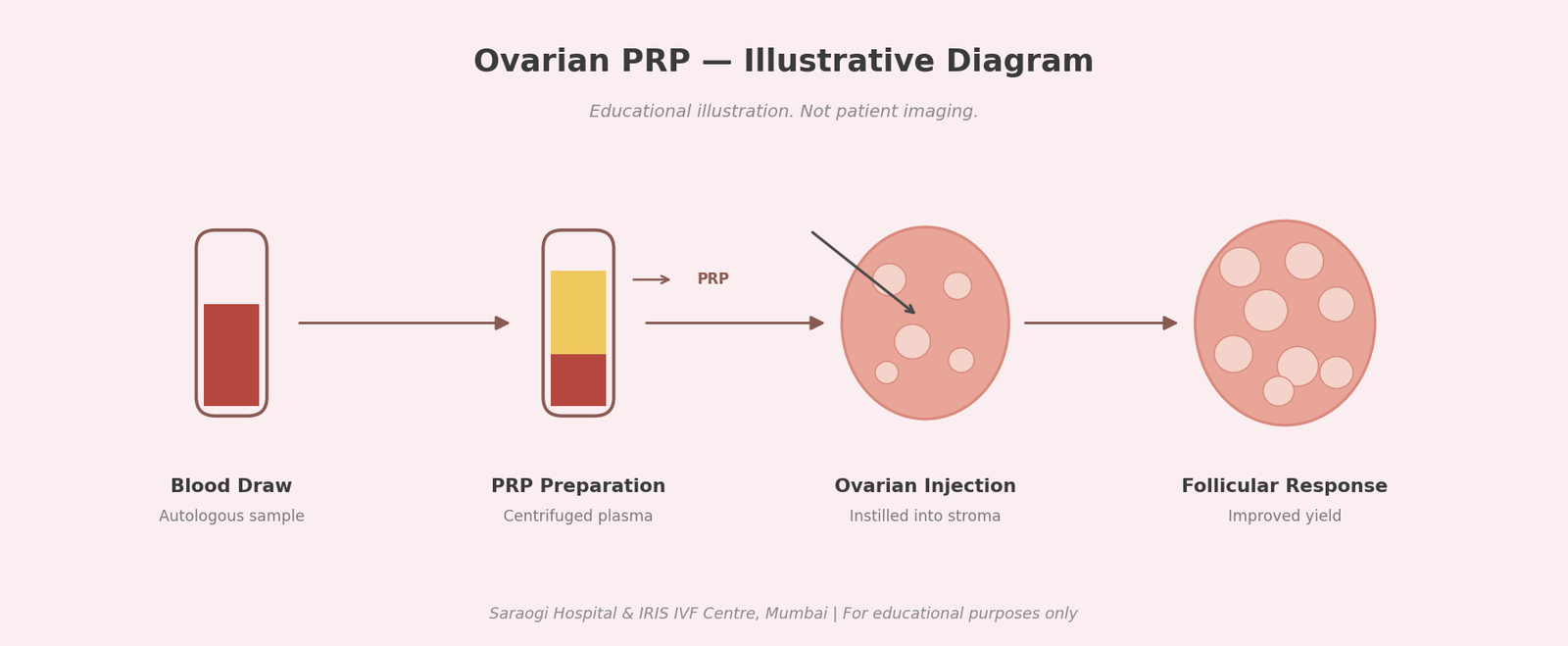
The patient underwent multiple IVF cycles across two clinics before returning to Saraogi Hospital for ovarian PRP, a repeat hysteroscopy with cervical shaving, and a final stimulation cycle designed around ovarian pooling. The illustration below outlines how ovarian PRP works: a blood sample is drawn, processed to separate platelet-rich plasma, and instilled into the ovarian stroma to support follicular response in a subsequent cycle.
PROCEDURE DETAILS
- First stimulation cycle at Saraogi Hospital: 4 oocytes retrieved, most of which arrested and were immature; one Grade B embryo was formed
- Cervix found to be tight while preparing for transfer; hysteroscopy, metroplasty, and cervical shaving performed (without electrocautery at that stage); an intrauterine Foley catheter was placed before lining preparation
- First embryo transfer technically difficult due to cervical stenosis; the cycle failed
- Second stimulation cycle: 4 oocytes retrieved, forming one Grade A embryo; patient maintained on antioxidants and fertility-friendly lifestyle modifications throughout; transfer performed and failed
- Patient took a break and travelled to her hometown of Nanded, where she underwent five further egg retrievals; four cycles produced no viable embryos, and the fifth produced one embryo that was transferred and failed
- On return to Saraogi Hospital, ovarian PRP (ovarian rejuvenation) was performed, instilling platelet-rich plasma into the ovarian stroma to support oocyte quality and quantity
- A repeat hysteroscopy with cervical shaving was carried out alongside the PRP procedure
- Stimulation was planned around the concept of ovarian pooling; this cycle produced the patient’s best-ever yield of 7 oocytes, from which 4 embryos were formed
- Embryo transfer performed; beta hCG returned positive for the first time in this patient’s fertility journey
- A healthy foetal heartbeat was confirmed two weeks after the positive beta hCG
PROCEDURE FACTS
|
Procedure |
Ovarian PRP with Repeat Hysteroscopy, Cervical Shaving, and IVF with Ovarian Pooling |
|
Embryos Generated (Final Cycle) |
4 embryos from 7 oocytes, the patient’s best yield across her fertility journey |
|
Cervical Finding |
Cervical stenosis identified during the first cycle; managed with hysteroscopy, metroplasty, and cervical shaving |
|
Total Egg Retrievals |
8 across both clinics (2 at Saraogi Hospital, 5 in Nanded, 1 following ovarian PRP) |
|
Current Status |
Positive beta hCG with confirmed foetal heartbeat at two weeks |
OUTCOMES AT A GLANCE
|
Conception |
Achieved following ovarian PRP, repeat hysteroscopy, cervical shaving, and a stimulation cycle built around ovarian pooling |
|
Oocyte Yield |
Best-ever retrieval of 7 oocytes, compared to 4 or fewer in every prior cycle |
|
Embryo Yield |
4 embryos formed, more than any single previous cycle |
|
Cervical Factor |
Corrected through hysteroscopy and cervical shaving, addressing a barrier that had complicated earlier transfers |
|
Current Pregnancy Status |
Positive beta hCG with confirmed foetal heartbeat at two weeks |
CURRENT STATUS AND ONGOING CARE
The pregnancy is currently in its early stages, with a positive beta hCG and a confirmed foetal heartbeat at two weeks post-positive result. Given the patient’s history of primary ovarian insufficiency and her Rh-negative blood group, she continues to be monitored closely as her antenatal care progresses.
TREATMENT TIMELINE
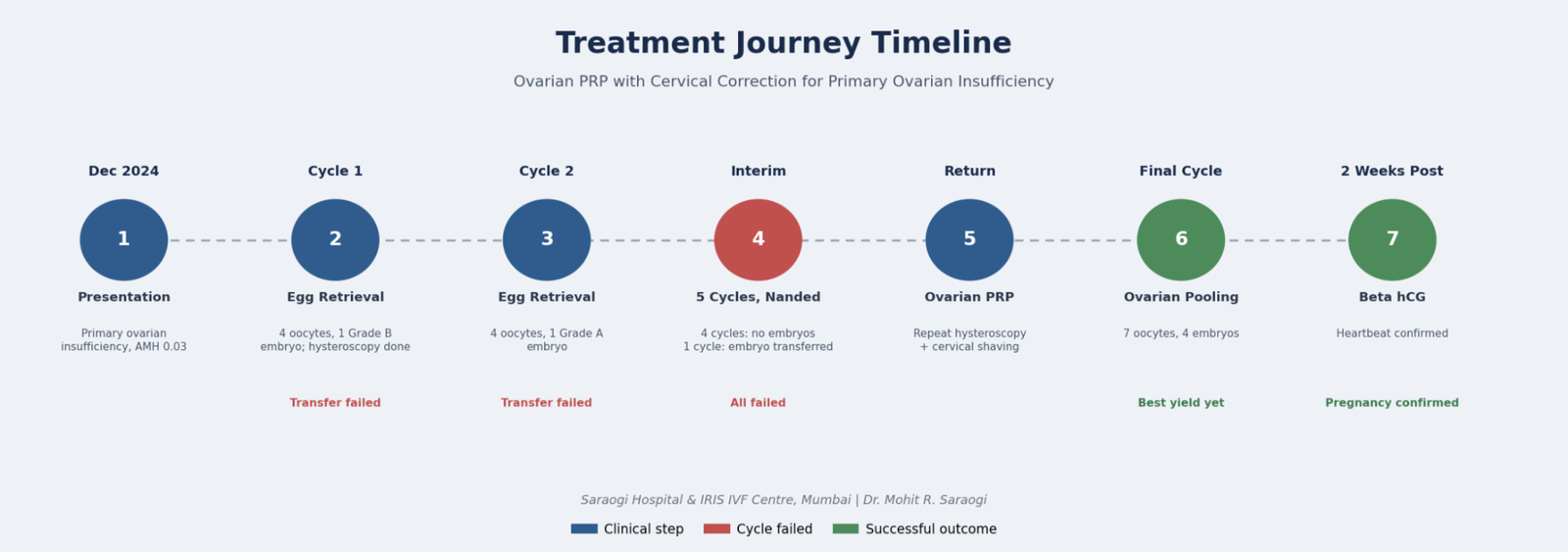
| December 2024 | First presentation at Saraogi Hospital; diagnosed with primary ovarian insufficiency |
| Cycle 1 | 4 oocytes retrieved, 1 Grade B embryo formed; hysteroscopy, metroplasty, and cervical shaving performed; transfer failed |
| Cycle 2 | 4 oocytes retrieved, 1 Grade A embryo formed; transfer failed |
| Interim (Nanded) | 5 further egg retrievals; 4 cycles produced no embryos, 1 embryo transferred and failed |
| Return to Saraogi Hospital | Ovarian PRP performed with repeat hysteroscopy and cervical shaving |
| Final Cycle | 7 oocytes retrieved, 4 embryos formed; embryo transfer performed |
| Two Weeks Post-Transfer | Beta hCG positive for the first time; healthy foetal heartbeat confirmed |
Disclaimer: This case study is for informational purposes only and does not constitute medical advice. Individual results may vary. Consult a qualified fertility specialist before undergoing any procedure. Patient identity withheld per confidentiality guidelines.
WHY CHOOSE DR. MOHIT SARAOGI FOR OVARIAN PRP AND COMPLEX FERTILITY CASES
Dr. Mohit R. Saraogi has treated patients with primary ovarian insufficiency, extremely low ovarian reserve, and repeated IVF failure at Saraogi Hospital and IRIS IVF Centre. Cases like this one, where a critically low AMH, a cervical factor, and a long run of failed embryo transfer cycles across two clinics all needed to be addressed together, are managed with a willingness to revisit the treatment plan rather than repeat the same protocol indefinitely. Ovarian PRP, combined with correcting the cervical stenosis that had complicated earlier transfers, is one part of that broader approach to patients who have already been through a difficult and disheartening fertility journey elsewhere.
For patients with a very low AMH or a history of poor response to stimulation, a fresh evaluation can sometimes uncover factors, cervical, uterine, or otherwise, that earlier cycles may have missed.